Admissions: Frequently Asked Questions
A midwife is a primary health care provider who is legally licensed to give supervision, care and advice to clients during pregnancy, labour and the postpartum period, to conduct deliveries on their own and to care for the newborn child.
For more information about the role and scope of midwives in Ontario see the website. See also the
Midwives are clinical health care providers. Most work in midwifery practices providing antenatal, intrapartum and postpartum care. Midwives typically care for clients from the beginning of pregnancy until 6 weeks postpartum. Some midwives have also gone onto to work in policy, government, and other health related fields. While most midwives work in midwifery practice groups, some midwives work for other health care organizations such as community health centers and hospitals.
No. Midwifery is an autonomous profession separate and distinct from nursing and medicine. While there are basic skills that are common to all three professions, midwifery has a unique scope of practice and model of care. If you are a nurse with labour and delivery experience, you may be interested in our accelerated (PDF file) 2 year Post Baccalaureate for Health Professionals Program.
Midwifery students come from a wide variety of educational backgrounds. Many of them have received previous university undergraduate degrees while others have graduate degrees, college diplomas, or are mature students. Prospective students are strongly recommended to have completed a minimum of one year of university education.
Past experience may be taken into account during the selection process, but it is by no means a necessary requirement for acceptance into the Program. Applicants are assessed for those qualities that will enable the individual to become a good midwife. Places in the program have been offered to applicants from many different walks of life.
A newly graduated midwife working full-time can expect to earn around $100,000 (before taxes). Midwives' incomes increase with experience and grow to approximately $120,000 per year.
With demand for midwives exceeding supply, there are many opportunities for graduates to fill positions in Ontario and other provinces in Canada. Once students complete the Program, they must write the Canadian Midwifery Registration Exam (CMRE) and then they are eligible to apply to the College of Midwives of Ontario for registration and are required to work in an established midwifery practice for one year. ³Ô¹ÏÖ±²¥ graduates have successfully found positions in midwifery practices across Ontario and other parts of Canada.
The educational program is based on the following beliefs and values:
WE BELIEVE that midwifery has the potential to be one of the most important components of health care for pregnant and birthing people in Ontario. Midwives’ expertise in the care of normal pregnancy and childbirth arises from their understanding of childbearing as a social, cultural and biological process and from their ability to competently exercise clinical skills and decisionÂ-making. Midwifery education must provide the base for sound professional practice.
WE BELIEVE that midwives are the best persons to teach the professional practice of midwifery. In addition WE BELIEVE that the educational program has a special responsibility to foster partnerships between midwives and other health care providers for the benefit of students and people who seek midwifery care.
WE BELIEVE the educational program is an integral part of the evolution of the profession of midwifery in Ontario and Canada. The program must help create future leaders and teachers. It must establish practice and teaching as a continuum so that learning environments become available across Ontario.
WE BELIEVE the educational program will best assure the acquisition of knowledge, skills and values, and foster critical thinking if the academic setting is respectful of students, is committed to scholarly enquiry and emphasized the lifelong ability to learn and change.
WE BELIEVE that accessible education, which is both flexible and culturally sensitive, requires high quality distance education.
WE BELIEVE that the collaborative model of program development and management described herein provides both a reflection of and a model for professional practice in the field of midwifery.
In addition to meeting competitive academic requirements, you are required to submit the following non-academic requirements. Your ability to follow and adhere to the requirements is part of the assessment of your application.
The Midwifery Form has 4 subsections:
1. Program of Study Preference
Applicants are provided information about the different programs of study available at the TMU MEP. These include the (PDF file) 4 year full time, (PDF file) 5 year part time and (PDF file) 2 year Post Baccalaureate Program for Health Professionals (PBHP). Applicants are asked to state their preferred program of study. Applicants wishing to be considered for the PBHP are required to provide additional documentation. Successful applicants are informed of their program of study as part of their offer of admission.
2. Placement Area Preference
Applicants are provided information about the two different TMU MEP geographical placement areas, which we refer to as the GTA (greater Toronto area) and the GOA (greater Ontario are). Applicants are asked to provide their preference for their placement area. Placement areas are assigned at the time of admission and are included in offers of admission. Students will not be able to request a switch between placement areas after admittance. Please review the MEP website for information about both areas.
3. The Racial Equity Admissions Self-ID
The Racial Equity Admissions Self-ID is used to promote equitable representations of Black, Persons of Colour (BPOC) and/or racialized people in the multiple mini interviews for admission. Further information on this process can be found on our website here: The Racial Equity Admissions Self ID.
4. The Indigenous Admissions Process
The Indigenous Admissions Process (IAP) is designed to counter some of the systemic disadvantages that may affect Indigenous applicants' access to the program. Further information on this process can be found on our website: The Indigenous Admissions Process. Applicants who choose to self-identify as Indigenous, First Nations, Métis, or Inuit can indicate that they wish to participate in the IAP by completing this section of the Midwifery Form.
Applicants are required to submit the Midwifery Form by February 1.
1. Access your ChooseTMU Applicant Portal account.
Here's how to access your ChooseTMU Applicant Portal account:
a. Get your TMU Student Number in the email acknowledgement of your application.
b. Activate your TMU Online Identity. Fill in the Activation Form on the Accounts website. When asked for your Student/Applicant ID, enter your nine-digit TMU Student Number. Keep a record of your user name and password.
c. 24 hours after activating your TMU Online Identity, visit the
2. Click on the button to link to the eForms Centre.

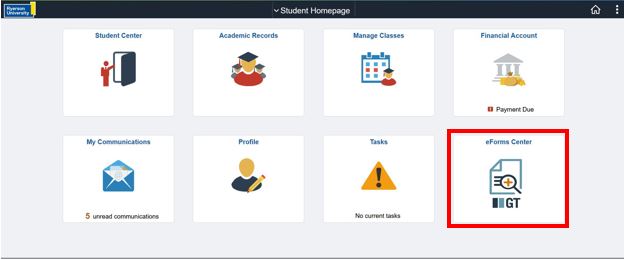
3. Next, click on the eForms Centre tile.
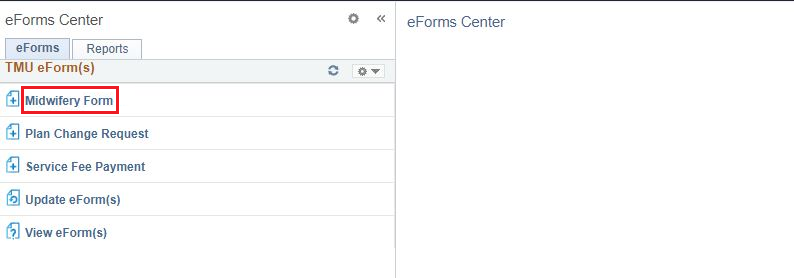
4. Then click on the Midwifery Form link.
Students in the Midwifery program must cover tuition, ancillary and other University fees. For 2 1/2 years of their studies, students in the program are in clinical placements and are required to provide their own means of reliable transportation. Students are placed in more than one midwifery practice during their time in the MEP and may need to relocate for clinical placements. Travel and living expenses are the responsibility of the student. It is not possible to maintain outside employment while in clinical placements. Careful financial planning is required in order to participate in the program.